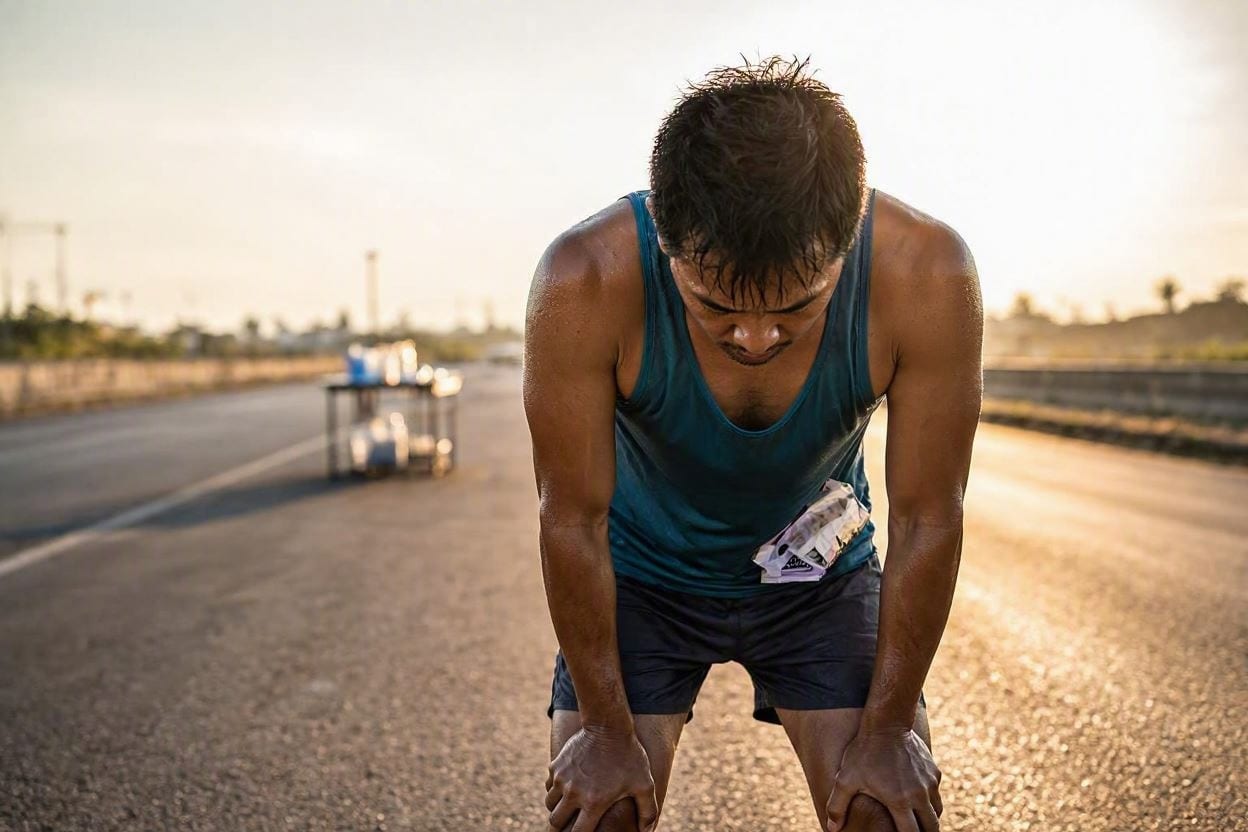
You are 30 kilometers into a marathon and running well. Then, over the space of about half a kilometer, everything changes. Your legs stop responding. Your pace falls apart even though you are trying harder than before. The finish line, which felt inevitable ten minutes ago, suddenly feels impossible — and you find yourself doing arithmetic about how long it would take to walk the rest.
That is the wall. It is one of the few experiences in running that is genuinely as bad as its reputation, and it is also one of the most preventable.
What Does Hitting the Wall Mean?
Hitting the wall, or bonking, is what happens when your muscles run out of stored glycogen mid-race.
Glycogen is the carbohydrate your body keeps in your muscles and liver, and it is your fast fuel — the one that lets you run at pace. You also burn fat, which you have in near-unlimited supply, but fat burns slowly and cannot sustain race effort on its own. When the glycogen runs out, your body is forced onto fat alone, and your pace drops off a cliff whether you agree to it or not.
It is not a failure of willpower. It is a fuel system running dry, which is why trying harder does almost nothing. You will find "bonk" and the rest of the vocabulary in our glossary of 25 running terms every Filipino runner should know.
Why Does It Happen at Kilometer 30?
The number is not folklore. A trained runner stores roughly 1,800 to 2,000 calories of glycogen, and running burns somewhere around 60 to 70 calories per kilometer depending on body weight and pace. Divide one by the other and you land at about 30 kilometers.
Which is exactly why the wall is a marathon phenomenon. A 42K is roughly 12 kilometers longer than your tank, so the gap has to be covered by fuel taken in during the race. A 5K or 10K is far too short to empty your stores — if you fall apart in a 10K, that is pacing, heat or dehydration rather than a true bonk. A 21K sits in between: a badly fuelled, badly paced half in Cebu heat can produce something that feels a lot like the wall, usually milder.
What Does Hitting the Wall Feel Like?
Runners describe it with striking consistency:
- Sudden heaviness — legs go from working to unresponsive within a kilometer or two.
- Pace collapse — you are pushing harder and running significantly slower. Effort and output disconnect.
- Mental fog — your brain runs on glucose too. Simple pace maths stops working.
- A sharp mood drop — sudden hopelessness, irritability, sometimes tears. This is chemistry, not character.
- Shakiness and chills — low blood glucose symptoms, sometimes with goosebumps in tropical heat.
The distinguishing feature is how abruptly it arrives. Normal late-race fatigue builds gradually and stays negotiable — you can still respond when you decide to push. The wall does not negotiate.
How Do You Avoid Hitting the Wall?
Three things prevent it, and they work together. Two of them happen before you ever reach the start line.
1. Pace conservatively in the first half
The most common cause of the wall is not poor fuelling — it is starting too fast. Running faster than your aerobic pace shifts you toward burning a higher proportion of glycogen, so an over-eager first 10K quietly spends fuel you will desperately want at kilometer 32.
Going out too hard is the single most expensive mistake in long-distance racing. Our guide to pacing a 5K and 10K teaches the discipline at shorter distances, and the same principle scales up: the first half should feel too easy. Run Buddy calls your pace out loud while you run, which is the practical way to catch yourself drifting fast in the first hour when adrenaline is lying to you.
2. Fuel during the race
For anything beyond about 90 minutes, you need carbohydrates on the move. The working guideline is 30 to 60 grams per hour, starting from the first hour rather than waiting until you feel empty.
That last point matters more than anything else here. By the time you feel the wall, it is roughly 20 minutes too late to prevent it. Fuel on a schedule, not on feel. Gels, bananas at the aid stations, sports drink, even sweets — the specific source matters far less than taking it consistently and having practised it in training. Race day is not the morning to try a new gel brand.
3. Build the aerobic base
The long-term fix. Lots of easy running improves your body's ability to burn fat at a given pace, which spares glycogen and effectively pushes the wall further out. This is the real payoff of the slow running described in our guide to Zone 2 running for Filipino runners, and it is also why the long run is the session you never skip.
What About Carb Loading?
Topping up your glycogen stores in the two or three days before a long race genuinely helps — it does not create new capacity, but it makes sure you start full rather than three-quarters full.
In practice it means shifting the balance of your meals toward carbohydrates while your training volume is already low, which lines up neatly with taper week. Rice makes this easy in the Philippines. What it does not mean is one enormous pasta dinner the night before, which mostly produces a heavy stomach at the start line. Our guide to what to eat before a fun run in the Philippines covers the local options, and taper madness explains why the same week will have you feeling heavy and doubting everything.
The Cebu Heat Makes the Wall Come Sooner
Running in Philippine heat and humidity raises your heart rate at any given pace, which nudges you toward burning more glycogen for the same speed. Dehydration compounds it, and heavy sweating strips the sodium you need to absorb fluid and fuel properly.
The result is that a marathon here can produce something wall-shaped earlier than the textbook 30 kilometers. Three adjustments matter. Pace the first half by effort rather than by the number on your watch. Take fluid at every single station from the start, not just when thirsty. And take some salt — most Philippine races hand out electrolyte drinks, and a salt tablet or two is cheap insurance on a 42K.
Both of Cebu's big marathons sit in the rainy season for exactly this reason. Our Cebu Marathon 2026 guide covers the Discovery Marathon and Cebu Tricity Marathon dates, gun times and what the conditions actually do to your race plan.
What Should You Do If You Hit the Wall Mid-Race?
Sometimes it happens anyway. It is recoverable — partially, and slowly — if you respond correctly instead of fighting it.
- Take carbohydrates immediately — gel, banana, sports drink, whatever the next station has. It takes 15 to 20 minutes to reach your muscles, so the sooner it goes in the sooner the clock starts.
- Slow down on purpose — a deliberate slowdown you control is far better than the collapse that follows fighting it for another two kilometers.
- Drink at every station — dehydration is almost always part of the picture by this stage.
- Walk if you need to — a two-minute walk while fuel absorbs frequently produces a faster finish than grinding on at a crawl.
- Shrink the distance — stop thinking about 10 kilometers. Run to the next lamp post, then the next water station. Small targets are all your brain can process on low glucose.
Your goal time is gone. Accept it early and the finish line is still very much available.
The Mental Side
The mood crash is the part nobody warns you about. Low blood glucose affects your brain directly, so the despair that arrives at kilometer 33 feels like a considered judgement about your ability rather than a symptom of an empty tank.
Knowing that in advance is genuinely protective. When the voice shows up telling you that you are not a real runner and should quit, you can recognise it as low blood sugar with opinions. Take a gel, slow down, and notice how much of that certainty quietly evaporates twenty minutes later.
The wall is a fuel problem, so it needs fuel. But the ordinary late-race grind that is not the wall responds to something else entirely — our guide to staying mentally strong in the final kilometers covers the techniques that work when your fuel is fine and it simply hurts.
Recovering Afterwards
Bonking empties you out more thoroughly than a normal hard race, and it takes longer to come back from. Refuel within the first hour with carbohydrates and some protein — our list of post-run snacks for Filipino runners covers the local options that actually help. Rehydrate with something containing salt, not just plain water.
Then give it real rest. Several full days off after a marathon, especially one that ended badly, before you even think about an easy recovery run. Pushing back into training on emptied legs is a reliable route to the most common running injuries.
Log the Race — Especially the Bad One
The instinct after a race that fell apart is to forget it happened. Do the opposite.
Write down where the wall hit, what you had eaten, what your first-half pace was, and what the weather did. That is the data that stops it happening again — and the pattern almost always turns out to be the same two things: went out too fast, fuelled too late. You cannot see that pattern from memory. You can see it instantly from a race history.
Hitting the wall is only one of the ways a race can come apart, and the recovery process is much the same for all of them. Our guide to what to do when your race doesn't go to plan covers cramps, heat, DNFs and the post-mortem worth doing three days later.
Log your races free on RunMate, bad ones included. The race where you bonked at kilometer 30 is the one that teaches you the most, and the medal counts exactly the same on your wall. Then find your next one on the list of upcoming fun runs and marathons in Cebu and the Philippines, and go do it properly.
— Norman, founder of RunMate
Frequently Asked Questions About Hitting the Wall
What does hitting the wall mean in running?
Hitting the wall, also called bonking, is the sudden and severe drop in energy that happens when your muscles run out of stored glycogen. It typically strikes around kilometer 30 of a marathon. Your pace collapses, your legs feel unable to respond, and your mood drops sharply — all within the space of a few minutes.
At what distance do runners hit the wall?
Most runners store enough glycogen for roughly 30 kilometers of running, which is why the wall is associated with the 42K marathon. It is rare in a 5K or 10K — those distances are too short to empty your stores. A poorly fuelled or badly paced 21K can produce something similar, though usually milder.
How do you avoid hitting the wall?
Three things prevent it. Pace conservatively in the first half so you burn fat rather than glycogen early on. Take carbohydrates during the race, roughly 30 to 60 grams per hour after the first hour. And build a strong aerobic base in training with plenty of easy running, which improves your ability to use fat for fuel.
What is the difference between hitting the wall and just being tired?
Normal race fatigue builds gradually and you can still respond when you push. The wall arrives suddenly, often within a single kilometer, and your legs stop answering no matter how hard you try. Ordinary tiredness is negotiable. The wall is not — which is why it needs to be prevented rather than fought.
What should you do if you hit the wall mid-race?
Take in carbohydrates immediately, even though it takes 15 to 20 minutes to help. Slow down deliberately rather than fighting your pace, and drink at the next station. Then run by feel and break the remaining distance into very small targets. Walking a stretch to let fuel absorb often gets you home faster than grinding on.