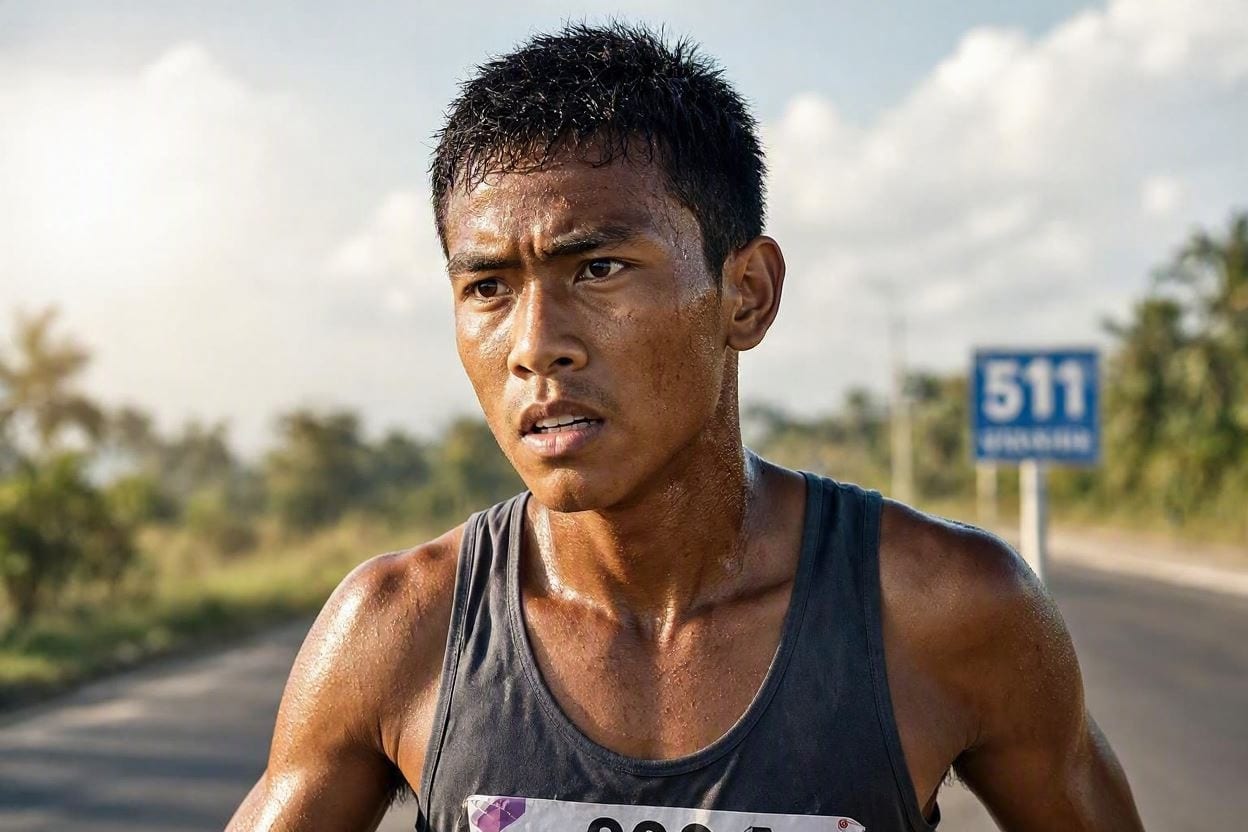
Every runner knows the moment. Kilometer 8 of a 10K, kilometer 17 of a 21K, kilometer 34 of a marathon. Your pace is still there, technically. Your legs are still working, technically. And a very reasonable voice in your head starts explaining that you could ease off right now and nobody would think less of you.
What you do in the next ninety seconds decides your race — and it has almost nothing to do with fitness. Everyone at that point in the race hurts. The runners still holding pace at the finish are not suffering less than the ones who faded. They just prepared for the conversation.
Why Do the Final Kilometers Feel So Hard?
Three things stack up at once, and understanding them makes them easier to handle.
Your muscles are genuinely fatigued, with accumulated damage and depleted fuel. Your brain is running its own protective programme, generating a rising sense of effort designed to make you slow down well before anything actually breaks. And in a Philippine race the heat is quietly adding to both — a rising core temperature is one of the strongest triggers for that "slow down now" signal.
The important part: that signal is conservative. Your brain applies a large safety margin. When it tells you that you cannot hold this pace, what it usually means is that it would prefer not to. There is almost always more available than the feeling suggests.
This is different from hitting the wall, which is an actual fuel system running dry and does not respond to mental technique. Knowing which one you are in matters — the wall needs carbohydrates and a slower pace, not a pep talk.
Pain Versus Discomfort — Learn the Difference
Before any of the techniques below, get this distinction clear, because it is the one that keeps you healthy.
- Discomfort — the general burn of hard effort. Spread across the body, heavy legs, laboured breathing. It eases when you slow. This is safe to push through, and racing well requires it.
- Pain — sharp, localised, and it changes your stride. This is a signal to stop, and pushing through it turns a niggle into one of the most common running injuries.
Mental toughness is for discomfort. Applying it to pain is not toughness, it is a six-week layoff.
Break the Distance Into Pieces
The most reliable technique there is, and the one experienced runners reach for first.
At kilometer 34 of a marathon, "8 kilometers to go" is an unbearable thought. Your brain cannot commit to it. But "run to that overpass" is completely manageable, and so is the next one after that.
Shrink the unit until it is something you can say yes to. Sometimes it is the next kilometer marker. Late in a hard race it might be the next lamp post, or a hundred more steps. Nobody is scoring how small the pieces get. String enough of them together and you have run the whole thing.
This works especially well on Cebu's long exposed stretches. On SRP you can see uncomfortably far ahead, which is psychologically brutal — pick a nearer target and refuse to look past it. Our guide to the best places to run in Cebu covers the routes where this matters most.
Prepare Your Words Before Race Day
Self-talk is one of the better-supported interventions in endurance sport, and it is nearly free. Runners given short prepared phrases to repeat during hard efforts hold those efforts measurably longer than runners left to their own thoughts.
Two details make it work. Prepare the phrases in advance — you will not invent anything useful at kilometer 34, when your brain is barely handling pace arithmetic. And address yourself as "you" rather than "I", which creates a small useful distance from the suffering.
- "You trained for this."
- "This is supposed to hurt. Keep going."
- "Relax the shoulders. Breathe out."
- "Just to the next marker."
It feels ridiculous the first time. It works anyway. Use them in training so they are familiar before they have to carry weight.
Run a Form Check Instead of a Feelings Check
When it gets hard, attention naturally turns inward and starts cataloguing everything that hurts. That is a loop with no exit. Replace it with a physical checklist you run top to bottom:
- Unclench your jaw and hands — gripping wastes energy and quietly raises your effort.
- Drop your shoulders — they creep up toward your ears when you are struggling.
- Lengthen your exhale — shallow panting makes everything worse. Push the air out.
- Lift your eyes — staring at your feet closes your chest. Look 20 metres up the road.
- Quicken your cadence slightly — shorter, faster steps are usually easier than long tired ones.
Running the checklist gives your mind a job. It also genuinely makes you more efficient, so you get a real physical return on the distraction.
Postpone the Decision to Quit
Do not argue with the urge to stop. Defer it.
Telling yourself "I will never quit" invites your brain to debate you, and at kilometer 34 your brain is a better debater than you are. Instead: "I will decide at the next water station." Then at the water station: "I will decide at the next kilometer."
The urge comes in waves rather than as a steady state, and most waves pass within a few minutes. Postponing costs you nothing and gets you through them. Runners are frequently surprised to find themselves at the finish having never actually made the decision at all.
Know Your Reason Before You Line Up
When it hurts, "because I signed up" is not enough. You need something with more weight behind it, and you need it decided in advance.
Something to prove to yourself after a hard year. A friend who got you into this. Wanting your kids to see the medal. A time you have chased for two seasons. Whatever it genuinely is, know it before the gun so you can reach for it at kilometer 34 instead of trying to construct one mid-race.
It also helps to think about who you are running with rather than only what you are running for. If you are training alone, running with a group gives the hard days a social weight that willpower alone does not supply.
Train the Discomfort, Don't Just Hope for It
Mental strength on race day is not a personality trait. It is a rehearsed response, and it is built in training.
Deliberately practise finishing the last portion of your long runs at goal pace, when you are already tired. That is the exact sensation you will meet late in the race, and meeting it for the first time on race day is a bad plan. Use your prepared phrases in those sessions. Run the form checklist. Make it all boringly familiar.
Pacing discipline does most of the heavy lifting here, and it starts earlier than you think — going out too fast is what makes the final kilometers unmanageable in the first place. Our guide to pacing your first 5K and 10K covers the discipline, and Run Buddy calls your pace out loud while you run so you can hold an honest effort without staring at a screen. If you are choosing tools, our comparison of the best jog apps for Filipino runners covers the options.
The Cebu-Specific Version
Heat changes the mental game, because your pace will be slower than the number you wanted and your watch will keep telling you about it.
Decide in advance to race by effort, not by pace, and to stop doing pace arithmetic entirely once the sun is up. Take water at every station from the start, including the early ones when you feel fine — dehydration late in a Philippine race attacks your mind as much as your legs.
And prepare specifically for the climbs if your race has them. The Busay ascent and the long exposed drag along SRP are where Cebu races are won and lost mentally. Break climbs into sections, shorten your stride, and accept the slower pace without treating it as a failure. Both of Cebu's big marathons put these stretches deep in the race — our Cebu Marathon 2026 guide covers what the courses actually do to you, and the Cebu fun run calendar has the shorter races worth using as practice.
It Starts Before the Gun
Two things set up your mental race before you have run a step. Taper madness in the final week will have you convinced you are undertrained — recognise it for what it is rather than letting it seed doubt you carry to the start line. And race day nerves at 4 AM are adrenaline doing its job, not a warning.
Runners who arrive at the start line already having lost the argument with themselves rarely win it at kilometer 34.
Collect the Evidence
Here is the thing nobody tells you about mental strength: it compounds, but only if you can see it.
The reason experienced runners hold on is not superior willpower. It is that they have a mental archive of times they wanted to stop and did not. That archive is what makes the voice at kilometer 34 less convincing — you have heard it before and you know how the story ended.
Most runners lose that archive. A year goes by, the hard races blur together, and the evidence disappears. Log every race free on RunMate, and write a line about the part where it got hard and what you did. When the doubt arrives in your next race, that record is what you reach for. You can also see how you stack up on the Cebu podium wall — though the finishes that build this are rarely the podium ones.
Pick your next test from the upcoming fun runs in Cebu and the Philippines. The hard part is the point. And on the easy days, the reward for all this is the runner's high that shows up when you are not fighting anything at all.
— Norman, founder of RunMate
Frequently Asked Questions About Mental Strength in Running
How do you stay mentally strong during a race?
Break the remaining distance into small pieces you can commit to one at a time, focus on your form and breathing rather than the finish line, and prepare a few specific phrases in advance to use when it hurts. The runners who hold on are not the ones who suffer less — they are the ones who decided beforehand how they would respond.
Why do the last few kilometers of a race feel so hard?
Physical fatigue and mental fatigue arrive together. Your muscles are tired, your fuel is depleted, and your brain begins protective signalling to make you slow down. In Philippine races the heat compounds all three. The discomfort is real, but it typically overstates how close you actually are to your limit.
What is the difference between pain and discomfort in running?
Discomfort is the burn of hard effort — general, spread across the body, and it eases when you slow down or stop. Pain is sharp, localised, and changes how you run. Discomfort can be pushed through safely. Pain is a signal to stop, because running through it is how a small problem becomes a long injury.
Does talking to yourself actually help when running?
Yes, and it is one of the better-supported mental techniques in endurance sport. Short, prepared phrases repeated during hard efforts measurably improve how long runners can hold an effort. Address yourself as 'you' rather than 'I', and prepare the phrases before race day rather than improvising while suffering.
How do I stop wanting to quit mid-race?
Make quitting a decision you defer rather than refuse. Tell yourself you will reassess at the next kilometer marker or water station instead of arguing about the finish line. The urge to stop comes in waves, and most waves pass within a few minutes if you simply postpone the decision rather than fighting it.